In General, Are There Any Major Differences That You Can See? Explain.
At the middle of the Pew Enquiry Center's mission is a delivery to measuring public attitudes on key issues and documenting differences in attitudes betwixt demographic and political groups.
An individual's age is one of the most common predictors of differences in attitudes and behaviors. On bug ranging from foreign diplomacy to social policy, age differences in attitudes can be some of the widest and most illuminating. Historic period denotes two important characteristics most an individual: their place in the life cycle – whether a immature adult, heart-aged parent or retiree – and their membership in a accomplice of individuals who were built-in at a similar fourth dimension. The nature of historic period equally a variable allows researchers to employ an approach known as cohort analysis to track a group of people over the class of their lives.
Age cohorts give researchers a tool to analyze changes in views over time; they tin can provide a mode to understand how dissimilar determinative experiences collaborate with the life-bike and aging procedure to shape people'south view of the world. While younger and older adults may differ in their views at a given moment, historic period cohorts allow researchers to become further and examine how today's older adults felt about a given issue when they themselves were young, too as to describe how the trajectory of views might differ across age cohorts.
Generations are 1 mode to group historic period cohorts. A generation typically refers to groups of people born over a 15-20 year span, such equally the Millennial generation, currently the youngest adult generation. Generational assay is an important tool used past Pew Inquiry Center and other researchers. This report aims to draw the basic approach of generational analysis at the Pew Research Eye and some of the primal insights it provides into understanding public attitudes and behaviors.
Defining Generations
The Pew Research Center'southward approach to generational analysis involves tracking the same groups of people on a range of issues, behaviors and characteristics. Setting the premises of generations is a necessary footstep for this analysis. It is a process that may be informed past a range of factors including demographics, attitudes, historical events, popular civilisation, and prevailing consensus among researchers. Every bit a result, the lines that ascertain the generations are useful tools for analysis, only they should be idea of as guidelines, rather than difficult-and-fast distinctions.
Each of the commonly-used current generations has been defined past a unique mix of factors.
The Baby Boom generation is an example of a generation that is largely delineated by census. Its oldest members were office of the spike in fertility that began in 1946, right after the end of World War 2. Its youngest members were born in 1964, shortly before a significant reject in fertility that occurred subsequently the birth control pill first went on the market place.
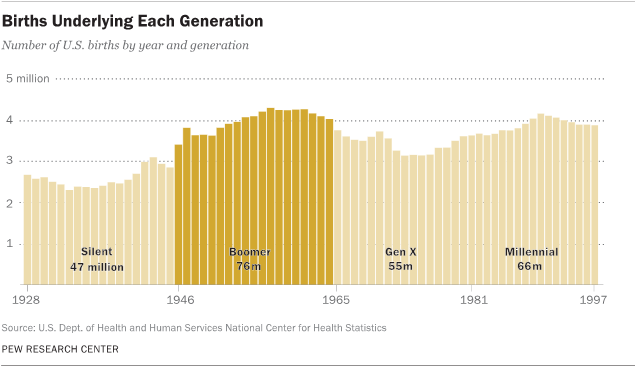
Other generations are less strictly defined by demography, though information technology plays an important role in designations including Generation X and Millennials – the two generations that followed the Baby Boomers.
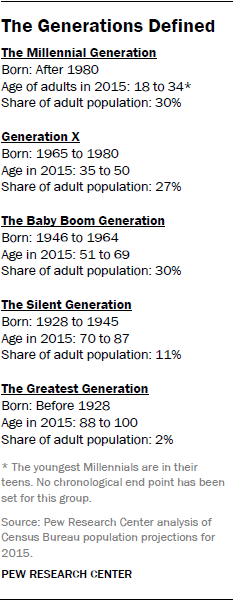 Generation X describes people born from 1965 through 1980. The label overtook the first name affixed to this generation: the Infant Bust. In part, this generation is defined by the relatively depression birth rates in these years compared with the Infant Nail generation that preceded them and the Millennial generation that followed them. The label for this generation was popularized by a 1991 book by Douglas Coupland titled, Generation 10: Tales for an Accelerated Culture.
The bounds of the Millennial generation, sometimes characterized as the "repeat boom," are also informed by demographics. This generation is largely fabricated up of the children of the Baby Boom generation. The name for this cohort refers to those born after 1980 – the first generation to come up of historic period in the new millennium. Equally this generation was first entering adulthood, some used the term Gen Y to refer to them, and its boundaries were slightly different. This is another example of how the names and spans of generations tin can change over time.
The Silent generation describes adults born from 1928 through 1945. Children of the Great Low and World War II, their "Silent" characterization refers to their image equally conformist and borough-minded. Time Magazine coined the term in a 1951 article describing the emerging generation of the fourth dimension. The Silent label is not widely recognized by the public: fewer say they have heard of information technology than the labels for any other of the living generations. (Run across here for our report on generations and identity.)
The Greatest generation (those built-in before 1928) "saved the world" when it was young, in the memorable phrase of Ronald Reagan. This is the generation that fought and won World War II, and became the subject of a all-time-selling book by Tom Brokaw. Pew Research Center no longer reports current data on the Greatest generation considering they now correspond such a pocket-size share of the adult population (roughly 2%) that standard public opinion surveys do not yield large enough sample sizes for reporting.
An age cohort spanning 15-20 years will necessarily include a various assortment of people — and frequently there are meaningful smaller cohorts inside these generations. Changes in political circumstances, societal mores and economical conditions over a menstruation of 15-xx years can lead to people within a accomplice having different formative experiences. Understanding these differences inside a cohort is an essential component of generational assay.
Life Cycle, Cohort, and Catamenia Effects
The factors associated with generational differences can be circuitous and overlapping. Researchers oftentimes think virtually 3 divide effects that tin produce differences in attitudes between age groups: life cycle furnishings (sometimes chosen historic period effects), catamenia effects and cohort effects.one
The first is the life cycle, or age, event. When a life wheel issue is at play, differences between younger and older people are largely due to their respective positions in the life wheel. For example, young people are far less likely than older adults to vote and appoint in politics. This may be because they are less informed about politics or feel they have less at stake in political or policy debates. Every bit people age, they vote at higher rates and their level of political date rises. Millennials are less engaged in politics today than are older generations, only the same was true of Baby Boomers in their youth. Today, Boomers are amid the most probable to vote and participate in politics.
The 2nd process is a period effect. Period effects are seen when events and circumstances (for instance, wars, social movements, economic booms or busts, scientific or technological breakthroughs) likewise every bit broader social forces (such as the growing visibility of gays and lesbians in club) simultaneously bear on everyone, regardless of age. Period effects are typically thought to have lasting effects on an entire population.
An case of a catamenia effect may be the impact of the events of the early to mid-1970s – the stop of the Vietnam State of war and the Watergate matter – on views of government. This was a time in U.Due south. history that coincided with a abrupt drop in public trust in government across generations. Overall trust in government has ebbed and flowed since the 1970s, only has never returned to levels seen before that period.
Another case of a lasting menstruum event is the shift in public views on the issue of terrorism and the priority given to homeland defense and combatting terrorism globally post-obit the September 11, 2001 terrorist attacks. However, other shifts in opinion following ix/11 proved to exist less indelible: expressions of patriotism and unity were short-lived equally the country presently entered a fractious debate over the Iraq war and deep partisan divisions on political issues soon reemerged.
Finally, there is a cohort effect.2 Differences between generations can exist the byproduct of the unique historical circumstances that members of an age cohort feel, specially during a time when they are in the process of forming opinions. In some cases, this may be the result of a period effect an older generation experienced that subsequent generations did not (eastward.g., the younger generations of today did not experience the Vietnam War or other social movements of the 1960s and 1970s, because they were not still born).
In other cases, a historical moment can have an outsize effect on members of one generation. This may be because information technology occurs during a primal point in the life cycle, such every bit adolescence and young adulthood, when awareness of the wider globe deepens and personal identities and value systems are beingness strongly shaped. The Great Depression and its backwash had the upshot of helping shape a cohort of Americans who were strong supporters of the Democratic Party for decades to come.
Understanding what drives generational differences strengthens our understanding of how public attitudes are being shaped. Is a shift in views broad-based, reflecting a fundamental change in how all generations view an result? Or is the change concentrated amidst a detail generation, reflecting the composition and determinative experiences of one group, merely not the public more broadly? These are some of the questions that cohort analysis – through the use of generations – help researchers answer.
Examples of Generational Assay: Same-Sexual activity Marriage and Marijuana Legalization
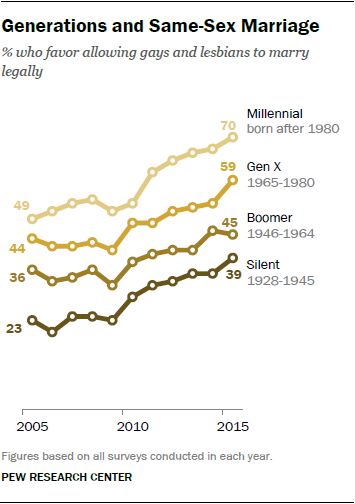 Views on the issue of same-sex marriage are a expert case of how researchers tin can use generations to empathize shifting public attitudes.
The accompanying nautical chart shows the percent that back up allowing gays and lesbians to marry legally across generations from 2005 to 2015. Over this time period, back up for aforementioned-sexual activity spousal relationship has grown from 36% to 55% among the public overall. (Run into this interactive for opinions of same-sex marriage over time.)
When it comes to same-sex marriage there take long been significant differences between older and younger people at individual points in time. Cohort analysis of these attitudes illustrates that these differences persist across the generations.
Millennials and Gen Xers came into the population more supportive of assuasive gays and lesbians to ally legally than older generations, and those greater levels of support take persisted over fourth dimension. Every bit a result, some of the explanation for an overall shift in attitudes about same-sex spousal relationship is attributable to a "generational replacement" as members of older, less supportive, generations laissez passer away, they are "replaced" in the developed population past members of younger, more supportive, generations inbound adulthood.
Merely at the aforementioned fourth dimension, all generations – younger and older alike – have get more than probable to support same-sex wedlock over the past decade, suggesting a menses result separate from age or accomplice.
Some other example of how generational assay can assist in understanding public stance is the example of attitudes about marijuana.
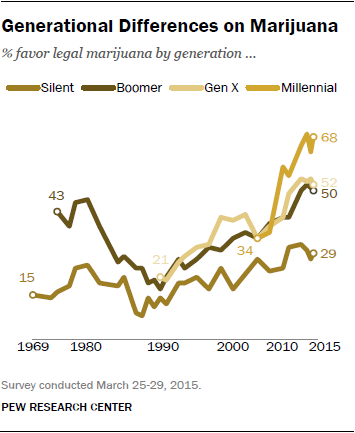 In recent years, in that location has been a fundamental shift in attitudes toward legalization of marijuana. When Gallup first asked virtually this consequence in 1969, just 12% of the public favored legalizing the use of marijuana, while 84% were opposed. In March of this year, 53% said the employ of marijuana should be made legal, while 44% disagreed. However, the shift in attitudes over fourth dimension has non been linear — support for marijuana legalization rose throughout the 1970s, fell in the 1980s, before steadily growing over the last quarter century.
The trend in stance on legalizing marijuana highlights how overall societal mood or forces (period) can shift attitudes, equally well every bit how people may exist differentially influenced by those forces at different ages (cohort). In 1973, the Baby Boom generation was coming of age, with its adult members and then between the ages of 18 and 27. At that time, 43% of Boomers favored legalizing the apply of marijuana; by comparison, just 16% of those in the Silent Generation (who were then ages 28 to 45) favored legalization.
During the 1980s, the administrations of Presidents Ronald Reagan and George H.W. Bush took a hard-line arroyo to illicit drug use as business organization over the dangers of marijuana rose. Between 1978 and 1990, support for the legal use of marijuana fell by 30 percent points among Boomers (from 47% to 17%) and past eleven points amongst Silents (from 25% to xiv%). Though one potential hypothesis is that these shifts were owing to life-phase (that people might become less supportive of marijuana as they motility into middle age) opinion amidst the youngest generation at that fourth dimension, Gen X, suggests the importance of the flow. Amidst Xers, whose oldest members were in their early on to mid-20s in 1990, simply 21% favored legalization at the time; they were far less supportive of legalization than Boomers had been at a comparable stage in their lives.
Since then, overall support for marijuana legalization has increased across all iii of these generations. But the patterns are somewhat unlike for each. Among Boomers, support for marijuana legalization now surpasses levels from when they were immature (50% today vs. 43% in 1973). Just among Silents, back up remains far lower compared to other generations: Their support for legal marijuana has been depression since the question was first asked in 1969 (when they were then 24-41), and today just 29% say it should be legal. Amid Gen Xers, who came of historic period in a period of piddling support for legalization, support has more than doubled since their youth (52% say its use should be legal today, compared to 21% in 1990).
Millennials (who were born in the 1980s and 1990s, and accept come of historic period in a period when back up for legalization was rise amidst their elders) are the most supportive of legalization: Since 2006, the share of Millennials favoring the legal use of marijuana has doubled, from 34% to 68%, reflecting a sharper rise in support than seen among Xers and Boomers.
While the generation lens is especially powerful for an outcome such as marijuana legalization, meaningful generational patterns are not seen beyond all issues. Views on gun control, for example, are an area where there are just small differences by generation, with larger opinion gaps seen across other variables, including gender, pedagogy and population density.
Central Differences Between the Generations
There are fundamental differences beyond generations, from their racial and ethnic limerick, to how rapidly they attain sure milestones such equally marriage, to their political and ideological orientations.
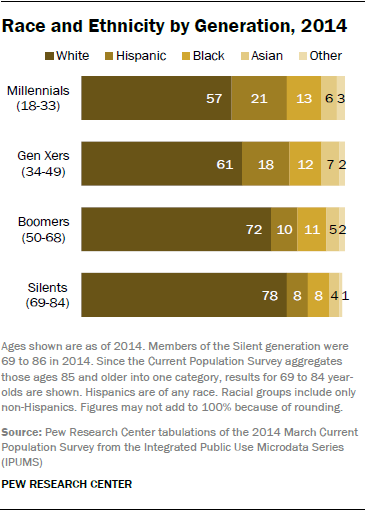 Some are enduring differences that will shape the generations over the course of their lifetimes. Others are largely a function of age or life-stage.
One example of an indelible difference beyond the current generations is their racial and ethnic composition. Millennials are the most various adult generation: 57% are not-Hispanic whites, while 21% are Hispanic, 13% are black and 6% are Asian. Each older generation is less diverse. Not-Hispanic whites make up 61% of Generation X, 72% of Baby Boomers and 78% of the Silent generation.
The current demographic composition of the state guarantees that the next generation will exist fifty-fifty more diverse than Millennials. The unique demographic profiles of the generations are unlikely to change a great bargain over time and often underlie stance dynamics on issues.three
In addition to their racial and indigenous composition, the generations also differ in life-shaping behaviors, such as marriage – behaviors that are not cast by the limerick of a accomplice but are informed by values and economic circumstances.
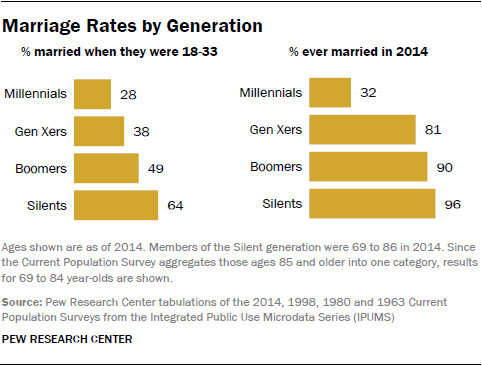 In 2014, only 28% of Millennials were married. This makes them remarkably dissimilar than members of the Silent Generation at the same stage in their lives: fully 64% of Silents were married when members of their generation were between the ages of 18 and 33. Near one-half (49%) of Baby Boomers and 38% of Gen Xers were married when their generation was ages eighteen to 33. Generational assay allows for these comparative snapshots, just it also lets researchers rails what happens as these cohorts age.
For example, just 38% of Generation X were married when they were ages xviii to 33, only many of those who weren't married at that historic period did not refuse the institution of spousal relationship altogether. Instead, a large share of Gen Xers take married subsequently in life than previous generations. As of 2014, fully 81% of Generation Ten (then ages 34-49) had ever been married, resulting in a narrowing of the gap betwixt Xers and the two older generations – Baby Boomers (ninety%) and Silents (96%) – in the percent who at that point had ever been married.
Marriage rates among Millennials are at an even lower starting point than for Gen Ten. Nevertheless, marriage rates will continue to rise among Millennials equally they historic period. The exact trajectory of marriage rates amongst Millennials is unclear, however. A recent Pew Research Center analysis projects that by the fourth dimension they accomplish middle historic period, as many equally 25% of Millennials will accept never married – an all-time loftier.
The blueprint of religious identity is another fundamental difference between the generations. Older generations identify overwhelmingly as Christian. For example, 85% of the Silent generation identify equally a member of a Christian denomination, while just 11% say they are religiously unaffiliated (defined every bit atheist, agnostic or "zip in detail"). Past dissimilarity, smaller majorities of Millennials (56%) and Gen Xers (70%) identify equally Christian, while every bit many as 35% of Millennials and 23% of Gen Xers do not place with any faith.
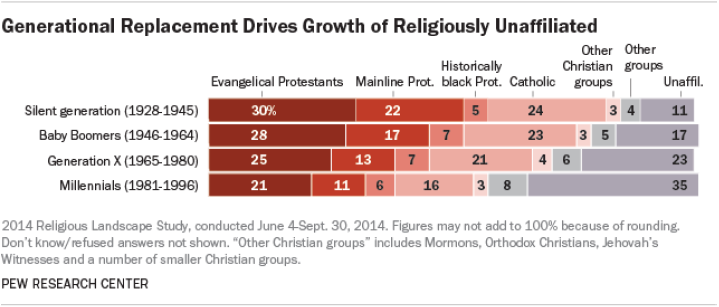
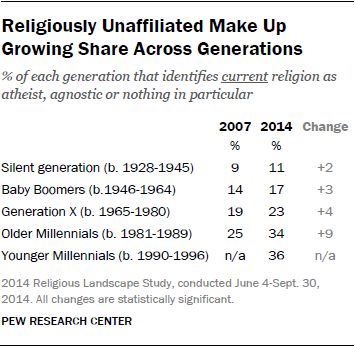 Over the past seven years, the share of the U.S. population that does not identify with an religion has grown since 2007. Much of this alter has occurred due to generational replacement; the youngest adults who are aging into the population are more probable to exist religiously unaffiliated than the oldest adults they are replacing.
While marriage rates are expected to rise amongst younger generations as they motility through the life bicycle, there is no indication that younger cohorts will become more religiously affiliated as they age. In fact, Pew Inquiry Center'southward 2022 Religious Landscape report found that the share of those who exercise not place with a religion had grown beyond generations. Between 2007 and 2014, for case, the share of older Millennials (born 1981-1989) who do non identify with a religion rose 9 percentage points, from 25% to 34%. Amidst Gen Xers, there was a 4-signal ascension in the share who do non identify with a faith (xix% in 2007 to 23% in 2014).
Partisan Amalgamation and Ideology
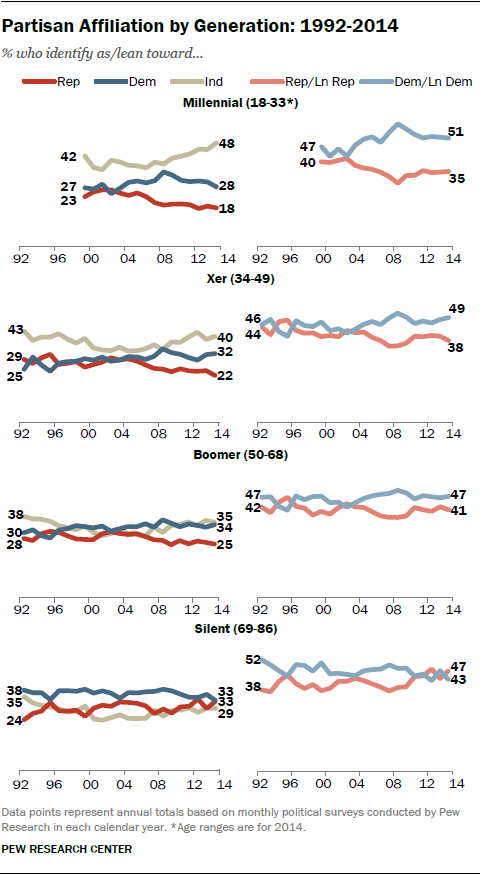 Overall, the share of political independents in the public has been rising in recent years, and in 2022 reached 39%, the highest percentage in more than than 75 years of polling.
An analysis of long term trends in political party identification, released in April, plant that Millennials are more likely than older cohorts to identify as independents. Nearly half of Millennials (48%) place as independents, compared with 40% of Gen Xers and smaller shares of Boomers (35%) and Silents (29%).
When the partisan leanings of independents are taken into account, Millennials are the most Autonomous generation, while Silents are the most Republican.
The political climate of early adulthood may continue to influence the political tilt of a generation throughout its life span, as noted in a 2022 Pew Research Heart report on generations. For example, members of the Greatest Generation, who came of age during the Nifty Depression and the Franklin Roosevelt administration, carried strong Democratic tendencies throughout their adulthood.
Yet the differences in partisan affiliation across generations tell only part of the story; there also is considerable variance within generations. And, with sufficient data, cohort analysis can be used to investigate inside-generation differences by examining smaller historic period spans.
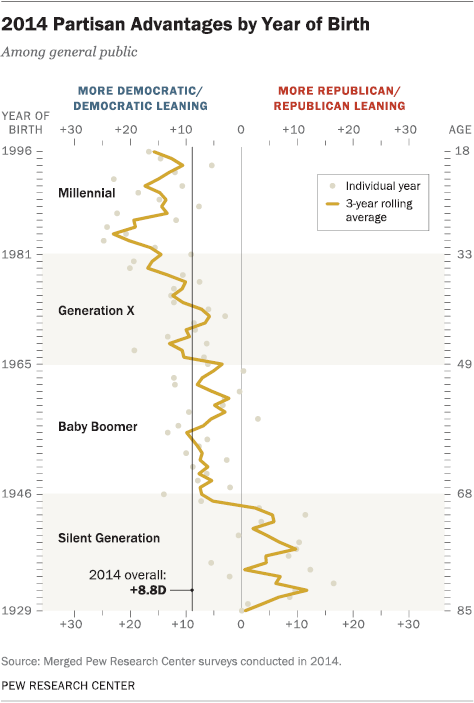 The accompanying graph showing partisan leanings in 2022 for adults based on the year they were born is an case of this. The line shows the per centum identifying or leaning Democratic minus the percent identifying or leaning Republican. The further left the line on the graph, the larger the Democratic advantage for that yr; the further right, the larger the Republican advantage.
Older Infant Boomers have consistently had a more Autonomous imprint than younger Boomers. Older Boomers were born in the late 1940s and early 1950s and came of voting age in the late 1960s and early 1970s, during Richard Nixon's presidency. Younger Boomers were born later (in the mid-to-late 1950s and early 1960s) and largely came of age in the 1970s and early 1980s, during the presidencies of Jimmy Carter and Ronald Reagan.
Older Gen Xers are more Republican (and less Democratic) than younger Gen Xers, whose strong Democratic leanings more closely resemble those of older Millennials.
 As with partisan amalgamation, there are substantial differences in the ideological leanings of generations. Based on data from the Pew Research Center's 2022 Political Polarization survey, Millennials are currently the least bourgeois generation.
Across a ready of 10 political values questions on issues such every bit the role of government, the surroundings and business concern, just 15% of Millennials express either consistently or mostly conservative views compared with 44% who take a mix of liberal and conservative views and fully 41% who express consistently or mostly liberal views. Past comparison, more than Gen Xers (25%), Infant Boomers (33%) and Silents (39%) express consistently or by and large conservative views across this set of ten questions.
The Mail service-Millennial Generation
Given all that we know about generations how do we place where to depict the line between the Millennial generation and the side by side generation? Today'south youngest adults are Millennials, simply the xvi-year span of Millennial birth years (1981-1997) is already near equally wide a range every bit those of the other living generations. And Millennials are projected to surpass Baby Boomers in 2022 as the nation's largest living generation, co-ordinate to a Pew Research Center analysis of Demography Bureau information. So it seems likely that in the near hereafter the youngest adults will be members of a post-Millennial generation.
Historical and demographic markers will factor into determining the dividing line between Millennials and post-Millennials. Simply it is unlikely that whatsoever single indicator or an 'aha' moment volition marker the cease of the Millennial generation, absent some unexpected consequence. More probable is that an finish-signal definition volition emerge over time every bit fence among researchers and usage in pop culture forms a working definition. As with Generation X and its original "Baby Bosom" characterization, at that place may be different names attached to the mail-Millennial generation earlier one somewhen sticks.
Regardless of where and when the line is drawn to terminate the Millennial generation, it will have several years before plenty post-Millennials have reached machismo to allow for meaningful statements nearly the next developed generation. One thing is clear: the next generation, today'due south children and teens, will likely be shaped by very different influences and forces than the generations that preceded it.
Source: https://www.pewresearch.org/politics/2015/09/03/the-whys-and-hows-of-generations-research/

Postar um comentário for "In General, Are There Any Major Differences That You Can See? Explain."