6 mistakes that white parents make about race - and how to remedy them
© 2022 Gwen Dewar, Ph.D., all rights reserved
 opens Paradigm file
White parents need to talk with their children about race, but mistaken beliefs often get in the manner. Here's what parents need to know to get improve agents of change.
For years, researchers have documented the phenomenon: Many white parents avoid talking with their children most race. Why?
One explanation — voiced past the parents themselves — is that they want their children to abound upward "color blind."
They don't want their children to think in terms of racial categorization. If I talk about race with my kid, wouldn't I exist undermining this goal? Wouldn't I be setting up my kid for a race-leap mentality?
Parents may besides believe that their children are also young to talk nigh race. They aren't equipped to sympathize the concepts. I should wait until my kids are at least 6, 7, or 8…
Or they might recollect that various alternatives are good enough.
What if I only teach my kid to care for everyone with fairness, without discussing race? Or expose my kid to lots of ethnic diversity? What if my child has an interracial friendship? Won't that be enough to protect my child from developing racist attitudes?
And of course parents avoid talking well-nigh race because of their own discomfort.
Some may worry that their anxieties will influence their children in a negative manner. If my child sees that I'm tense, could that end upwardly making things worse? Ameliorate to avoid explicit talk most race, and focus instead on a "color blind" approach to morality.
What does the research tell us virtually these strategies? Practice they lead to the best child outcomes? The best outcomes for racial justice?
Definitely not. There is no good substitute, no shortcut, for having frank conversations with your kid about race.
Kids learn about race whether or not we talk almost it. And they're equipped to handle the basic issues from an early on age.
When we don't explicitly accost race, we are leaving a vacuum to be filled by the popular culture.
When we don't explicitly teach kids — especially white kids — well-nigh the many forms of racism that be in our society, we aren't making them "color blind" so much as nosotros're making them "racism blind." And that allows racial injustice to continue.
Children encounter a steady stream of biases that harm people of colour and reinforce white privilege. Ignoring this doesn't make it get away. Information technology only ensures that children will abound upwardly perpetuating those biases.
So let's accept a closer look. What common mistakes are parents making? And what does the research reveal about the most effective ways to teach kids about race and racial injustice? Here's an evidence-based guide.
Debunking misconceptions: half-dozen mistakes to avoid
1. "My kid isn't old plenty yet."
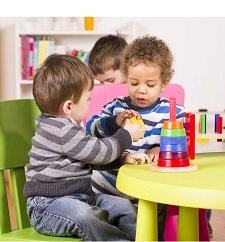
You might think that a toddler or preschooler isn't mature enough to handle a discussion about race. But this isn't likely.
If your child is old enough to talk, your child is well-nigh certainly old plenty to kickoff talking about race.
To meet what I mean, consider what babies know about the social world.
As I explain in elsewhere, opens in a new windowbabies feel empathy, and they evidence signs of having opens in a new windowa sense of fairness. By 12 months, many infants have learned to look that adults will distribute resources in a fair and equal style.
In addition, babies prove signs of a opens in a new windowmoral sense. When they witness an assault, they bear witness a preference for the victim, not the aggressor. And they adopt individuals who stand upwardly confronting aggressors. Not passive bystanders.
How practise these prosocial tendencies develop? Babies learn past interacting with us, and by observing acts of kindness and fairness.
Just let'due south be clear. Young children don't live in a fairy tale world of sweetness and light. They too observe bad beliefs. They learn near aggression and inequality. And that, too, influences their outlook.
Take the expectation about the off-white distribution of resources. Every bit it turns out, children change this expectation when they acquire crucial background information virtually the participants.
When toddlers learned that one individual was dominant over another, they didn't expect that each would receive an equal share. On the contrary, they seemed to expect that the authorisation figure would show favoritism toward the dominant private (Enright et al 2017).
You can read the details in this Parenting Scientific discipline article. But the takeaway hither is that basic morality — kindness, fairness, opposition to injustice — isn't a subject field that's likewise avant-garde for your kid to handle. On the contrary, it'south ane of the subjects your child knows the most virtually.
Young children are especially interested in how human being beings interact with each other. They are trivial anthropologists trying to learn how nosotros behave. So when we talk to them about treating others fairly — and how nosotros ought to respond to racial injustice — we aren't pushing a grown-upwardly agenda on them. We're speaking to concerns they already have.
2. What if I teach my kids the general principles of fairness and egalitarianism? Without bringing attention to race and racial labels? Isn't it best if I raise my kid to be "color-blind"?
This seems to be a very mutual approach. White parents avoid using race labels, like "black" or "white." They deliberately steer away from talk near race itself, in the hope that information technology will assistance prevent children from developing racial biases.
Does it work?
Not really. In the few cases where researchers have studied kid outcomes, they've noted a telling blueprint: The white, schoolhouse-anile children with the lowest levels of racial bias weren't the ones whose parents have taken a "color blind" approach.
On the contrary, the kids with the lowest levels of racial bias were the ones whose parents were "colour witting" (Katz 2003; Vittrup and Holden 2011).
Color conscious parents admit and address the being of racial categories. They admit and accost the existence of racism. And they do this with their kids — tackling the subject explicitly in family discussions.
iii. But if I start talking well-nigh race — and using race labels — won't that put ideas in my kid's caput? Isn't information technology better if my child never learns about racial categories to begin with?
I tin meet the reasoning. It's a kind of utopian science fiction premise, a "Garden of Eden" theory.
If nosotros never tell kids about race, they won't larn to exercise bad things in the proper noun of race. The future globe they create will be humanitarian and harmonious.
One big problem with this theory? Information technology presupposes that kids won't go aware of race unless nosotros talk to them about it. And that's been disproven.
For instance, practice parents talk to their 3-month-old babies about racial categories? Do they railroad train their 3-month-old babies to sort faces by race?
No. Nonetheless babies tin can do it.
In experiments, 3-calendar month-old infants show a basic ability to sort female person faces into at least ii categories: "my own race" and "not my own race." Babies prefer female faces of their own race, probably considering these faces more closely resemble their mothers (Them at al 2015; Liu et al 2011).
And when researchers have tested 8-month-olds, babies show a bias in facial recognition. They take little trouble distinguishing individuals of their own race. Merely when information technology comes to members of another race, they struggle. They accept difficulty telling individuals apart (Anzures et al 2012).
Why and then hard? It's probably because babies haven't yet encountered many faces. From solar day to day, they mostly run into members of their own family, individuals who often look quite similar to each other.
So it's like confront recognition software. To improve facial recognition abilities, your baby needs a more diverse range of examples to report. When researchers accept actively trained babies past showing them daily examples of other-race faces, the infants become more expert (Anzures et al 2012).
But the indicate here is that babies notice differences that can map onto our culturally-defined racial categories. And immature children observe other markers of "in-groups" and "out-groups," like differences in language and clothing.
By the time children are preschool-aged, they know a lot about the style that society divides people upwards, and this happens whether or not we've had family discussions about it.
Even more importantly, young children are exposed to racial biases and value judgements — simply by living in our culture. Which takes us to our adjacent bespeak.
4. Why should I have to worry near my kid absorbing racial biases and attitudes? I don't endorse racism myself. Isn't it plenty if my kid grows upwardly around people with proficient intentions?
In one case once more, in that location'southward a problem with the underlying premise.
Studies ostend everybody is affected past bias — fifty-fifty people who are consciously opposed to racism. Good intentions aren't enough.
As opens in a new windowBeverly Daniel Tatum has put it, racial stereotypes surroundings u.s.a. like smog.
We're exposed to them in books, movies, television, and the cyberspace. Biases tin be observed on our streets, and in our classrooms. We absorb these biases, whether nosotros similar it or not. Even if we don't realize it.
The biases don't have to ascertain the states. Non unless we go through life acting on our impulses. The biases operate on auto-pilot. They influence behavior by affecting our intuitions, our firsthand, knee-jerk reactions.
And then if we're open to discovering these biases — if we question, analyze, and reverberate — we can counteract them.
That'south why the "color blind" approach doesn't work. That'due south why the "Garden of Eden" approach fails. Ignoring race doesn't make racial problems go away. It allows them to persist.
It makes privileged people less probable to notice racial biases — in themselves, and in others. Information technology makes white people less likely to notice biases in the way guild itself is structured.
And children are not immune. On the contrary. By the historic period of 3, 4, or v, kids take already been affected by the racial "smog."
For instance, in a recent written report, American preschoolers were shown photographs of other children, and their responses were recorded.
The preschoolers responded positively to all the immature faces they saw. Skillful news, right?
But some faces got more than love than others. Kids responded most positively to white female faces, and least positively to blackness male faces.
This blueprint held for white and non-white children akin, and information technology was observed in kids regardless of how much prior exposure they'd had to ethnic diverseness (Perszyk et al 2019).
A similar pattern was observed when researchers presented 5-yr-old girls with the opportunity to invite fictitious characters to a pretend political party. Girls preferred the invite white characters, whether or not they were white themselves (Kurtz-Costes et al 2011).
5. What nigh interracial friendships? If my child has friends from unlike backgrounds, won't that preclude my child from developing racial biases?
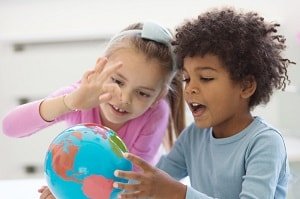
Cross-race friendships are rewarding on many levels, and they practice appear to reduce prejudice (Pettigrew and Tropp 2006).
Just they don't, past themselves, forestall kids from downloading the racial biases that are embedded in our culture.
Interracial friendships don't necessarily make children enlightened of the history of racism, or the ongoing forms of institutionalized racism that reinforce inequality.
And so we still need to tackle racism head-on. Nosotros notwithstanding need to talk nearly it. White kids need to know that it isn't an even playing field. They are accorded certain privileges in order simply by virtue of being white. Privileges that their not-white friends are denied.
6. I'yard going to exist tense, though. Won't that undermine the message when I talk to my kids nigh racism? Perchance it'due south better if I stay quiet, and stick with a "color blind" strategy.
A new, yet-to-be-published study has addressed this question.
White parents were asked to spotter brief, animated videos with their 9-year-old kids — cartoons that showed everyday incidents of racial discrimination.
Afterwards, the parents were instructed to talk almost these incidents with their children.
The researchers measured children'south implicit racial biases before and after the experience. They also measured levels of tension and anxiety that parents experienced.
Did parental emotions affect children's outcomes?
Yes. Children with specially tense parents didn't improve as much equally children with more than relaxed parents.
But here's the thing. The kids didn't get more biased. They either fabricated less progress, or no progress. They didn't get worse (Perry et al 2020).
And that should encourage you lot, even if you anticipate being tense or anxious. You're unlikely to cause any harm. And after making that outset attempt, yous volition have broken the water ice. You should find information technology easier the next fourth dimension.
So how do you lot take the commencement footstep?
Tips for talking to your kids near race and racism
i. Larn and keep on learning.
To assist your child acquire well-nigh race and racism, you demand to know what's going on. And chances are, it's worse than you remember — especially if you're white. White people don't accept direct experience with being a person of colour in a racist guild.
Of grade, at that place'southward nix we can practise about that. There'south no manner for a human being to re-live his or her lifetime in someone else'due south shoes.
But man beings tin can learn crucial lessons past listening to the personal experiences of others, and many people of color have generously shared their stories.
First-person accounts — like those of comedy writer Amber Ruffin — teach the states things we can't grasp from experiments and surveys. I highly recommend her drove of video talks, opens in a new window"Bister Ruffin Shares a Lifetime of Traumatic Run-ins with Police," which you tin watch on YouTube.
And of form parents also need to learn virtually the raw statistics and facts. For example, in the U.s.:
- Victims of fatal force — who were unarmed, male, and non-suicidal — are 13 times more probable to be black than white (Schimmack and Carlsson 2020).
- Black people are more than 3.5 times every bit probable equally white people to die of COVID-19 (Gross et al 2020).
- Black women are three times as probable as white women to die of childbirth complications. Their babies are more probable to die, too (Vilda et al 2019).
These are but a few of the disparities — a small-scale glimpse at the trouble. And in case you are wondering, these really are racial disparities. Well-nigh remain significant fifty-fifty after researchers control for an private's level of wealth and teaching.
Yet brand no fault, race-biased economic disparities contribute mightily to these issues. There is a profound racial wealth gap.
On average, black households have merely 10% of the wealth that white households do, and structural racism is to blame.
As researchers at Knuckles University explain, "it takes wealth to make wealth," and "blacks largely take been excluded from intergenerational access to upper-case letter and finance" (Darity, Jr., et al 2018). Read their report opens in a new windowhere.
ii. Check out the excellent article, "Talking to kids nearly race," by Heather Greenwood Davis.
The author interviews a variety of experts, and presents specific examples for discussing race with both preschoolers and older kids.
For example, what should yous exercise if hear your child make a value judgement based on race?
Good Maggie Beneke advises that you respond with "open, non-judgemental questions to understand why your child might be making that assumption." Get the conversation started by asking "Why do you think that?" And so explain what stereotypes are, and "work with your child to remember nigh examples that show how these stereotypes aren't actually true."
For more than helpful tips, opens in a new windowread the article on National Geographic.
3. Reinforce lessons about racial justice by nurturing your child'southward socio-emotional skills.
See these Parenting Science manufactures for aid:
- "Didactics empathy: Prove-based tips for fostering empathy in children"
- "Emotion coaching: Helping kids cope with negative feelings"
- "Social skills activities for children and teens"
References: Common mistakes that white parents make about race
Anzures 1000, Wheeler A, Quinn PC, Pascalis O, Slater AM, Heron-Delaney One thousand, Tanaka JW, Lee K. J 2012. Brief daily exposures to Asian females reverses perceptual narrowing for Asian faces in Caucasian infants. Exp Child Psychol. 112(iv):484-95.
Gross CP, Essien UR, Pasha South, Gross JR, Wong South, and Nunez-Smith M. 2020. Racial and Ethnic Disparities in Population Level Covid-19 Bloodshed. doi: https://doi.org/ten.1101/2020.05.07.20094250. Preprint accessed 6/6/2020 from opens in a new windowmedRxiv.
Katz PA 2003. Racists or tolerant multiculturalists? How practice they brainstorm? Am Psychol. 58(11):897-909.
Kurtz-Costes B, Defreitas SC, Halle TG, Kinlaw CR. 2011. Gender and racial favouritism in black and white preschool girls. Br J Dev Psychol. 2022 Jun;29(Pt two):270-87.
Liu South, Quinn PC, Wheeler A, Xiao N, Ge L, Lee 1000. 2011. Similarity and difference in the processing of same- and other-race faces equally revealed by eye tracking in iv- to 9-month-olds. J Exp Child Psychol. 2022 Jan;108(one):180-9.
Pahlke E, Bigler RS, Suizzo MA. Relations between colorblind socialization and children'south racial bias: bear witness from European American mothers and their preschool children. Child Dev. 2022 Jul-Aug;83(4):1164-79.
Perry S, Skinner AL, Abaied JL, Waters S. 2020. Preprint. Exploring how Parent-Child Conversations most Race influence Children'southward Implicit Biases. DOI: 10.31234/osf.io/3xdg8
Vittrup B. 2018. Colour bullheaded or color conscious? White American mothers' approaches to racial socialization. Periodical of Family unit Bug 39: 668–692.
Vittrup B and Holden GW. 2011. Exploring the bear upon of educational television and parent-kid discussions on children's racial attitudes. Analyses of Social Issues and Public Policy 11: 82–104.
Title prototype for "6 mistakes white parents brand about race" by Rawpixel / istock
image of preschoolers sharing blocks my dcdp / istock
image of child with thought bubble by BrianAJackson / istock
epitome of kids with earth past Liderina / istock
Content last modified 6/2020
Source: https://parentingscience.com/6-mistakes-white-parents-make-about-race/

Postar um comentário for "6 mistakes that white parents make about race - and how to remedy them"